Future-Proofing Development Workflows with Agile Methods
Development teams rarely struggle because they lack tools; they struggle because their workflow stops matching the pace of change around them. New product requirements, shifting security expectations, distributed teams, and faster release cycles all put pressure on how software gets planned, built, tested, and maintained. That is why agile methods remain relevant in 2026: not as a rigid framework to copy, but as a way to keep development work adaptable without losing discipline. For teams thinking about long-term resilience, the question is less whether to "do agile" and more how to shape an operating model that can absorb change, reduce waste, and keep delivery predictable. The practical answer usually involves a mix of iterative planning, tight feedback loops, visible work, and continuous improvement, supported by strong engineering habits rather than slogans. Resources such as the Agile Manifesto, Scrum.org, and Atlassian remain useful starting points, but the real value comes from adapting principles to the team's actual constraints.
Why agility matters when plans stop staying still
The strongest case for agile methods is not speed for its own sake. It is the ability to keep moving when assumptions change. In software, assumptions fail constantly: a feature that seemed small grows into a platform dependency, a compliance requirement appears late, or user behavior differs from product research. Traditional workflow models often assume that work can be fully specified in advance, but modern development rarely stays that tidy. Agile methods help teams make smaller commitments, inspect results earlier, and correct course before the cost of change becomes too high. That logic aligns well with broader industry guidance from organizations such as NIST on secure and reliable software practices, and with the engineering culture promoted by Google and Microsoft in their own developer ecosystems. The point is not to eliminate planning; it is to plan in a way that survives contact with reality. For organizations with public-facing products, internal pages like features and about can help frame how workflow choices support product capabilities and team values, while the homepage provides the broader context for the site's editorial focus.
What a future-proof workflow actually looks like
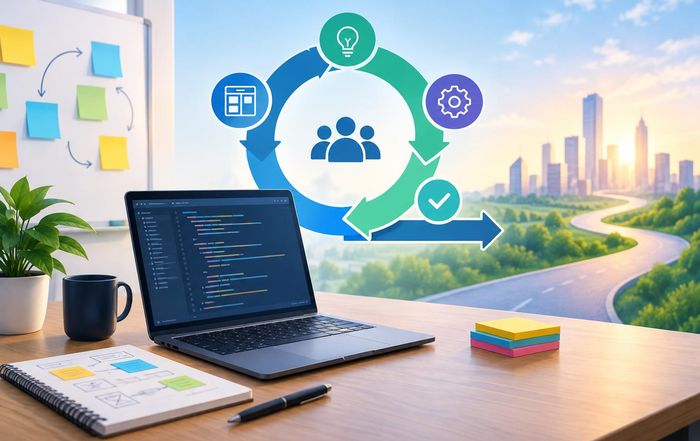
A future-proof workflow is usually less about a single framework and more about a set of habits that reinforce one another. Work enters the system through a visible intake process, gets prioritized against clear business goals, and is broken into increments that can be delivered independently. Teams review progress frequently, not just at the end of a release, and they treat testing, documentation, and deployment as part of the workflow rather than as afterthoughts. That is where agile methods become more than a planning ritual. When paired with version control, automated testing, and continuous integration, they create a delivery pipeline that can absorb change without collapsing into chaos. This approach is widely reflected in ecosystem guidance from GitHub, GitLab, and JetBrains, where the emphasis is increasingly on developer productivity and feedback speed rather than ceremony. It also helps to keep governance lightweight but real: teams need enough structure to avoid thrash, yet enough autonomy to respond quickly when priorities shift. The most resilient workflows tend to make progress visible, decisions reversible where possible, and quality checks routine rather than exceptional.
The engineering practices that make agile sustainable
Agile methods fail most often when they are treated as a project-management overlay on top of weak engineering habits. A team can run standups, retrospectives, and sprint planning and still ship slowly if code quality is unstable or the release process is fragile. Sustainable agility depends on engineering practices that reduce friction over time. Automated testing is a major one, because it lowers the cost of change and makes refactoring safer. Continuous integration matters for the same reason, especially when several people work on the same codebase. Clear branching strategies, code review discipline, and consistent environments also prevent small problems from turning into release blockers. Security deserves equal attention: modern workflows increasingly need to integrate threat modeling, dependency scanning, and secure coding checks early rather than bolt them on later, a view supported by OWASP and the Linux Foundation. In practice, future-proofing means designing the workflow so that good engineering is the default path, not an optional extra reserved for high-stakes releases. That is also where test environments, interface consistency, and release readiness become part of the same conversation instead of separate silos.
Team structure, communication, and the cost of coordination
Many workflow problems are really communication problems in disguise. As teams grow, coordinate effort becomes more expensive, and agile methods help only if they reduce that cost instead of adding meetings. The healthiest teams usually keep their collaboration patterns simple: a shared backlog, clear ownership, short feedback cycles, and visible definitions of done. Cross-functional collaboration matters because modern delivery often requires product, design, development, QA, and security to make decisions together rather than in sequence. That is especially relevant for organizations working across time zones or with distributed contributors, where asynchronous documentation becomes a core part of the workflow. Good agile practice makes room for that reality instead of pretending everyone can be available at the same time. For teams that support public websites or client work, internal pages like contact us and links can also serve as practical touchpoints for communication, reference, and navigation. The broader lesson is that agility is not a substitute for coordination; it is a way to make coordination cheaper, clearer, and less dependent on heroic effort.
Where agile methods need updating, not defending
Agile is not automatically the right answer to every workflow problem, and pretending otherwise is one reason teams become cynical about it. Some organizations have turned agile vocabulary into a performance ritual: lots of boards, ceremonies, and velocity tracking, but little real improvement in delivery or product quality. Others adopt agile in name while keeping decision-making centralized and releases heavily gated, which blunts the very flexibility the method is supposed to create. Future-proofing requires a more honest view. Teams should keep the parts that improve learning and delivery, and discard the parts that create overhead without value. That may mean fewer meetings, more asynchronous updates, better backlog hygiene, or a different cadence for planning and review. It may also mean recognizing when a product area needs more upfront design, stronger compliance checks, or longer stabilization periods. Frameworks from Scaled Agile and the broader industry conversation around lean delivery offer useful context, but they should be applied with judgment rather than treated as universal prescriptions. The most durable workflows are usually the ones that can be adjusted without a major reorganization every time conditions change.
Building a workflow that can still work next year
The goal of future-proofing is not to predict the future perfectly. It is to make the development system flexible enough that surprises do not become crises. Teams that do this well tend to invest in small batch sizes, strong automation, transparent priorities, and regular retrospectives that lead to actual change. They also keep an eye on the wider ecosystem: platform shifts, security expectations, tooling changes, and user expectations all influence how work should flow. In that sense, agile methods are best understood as a framework for learning faster than the environment changes. That remains useful whether a team is building a new product, maintaining a mature platform, or improving internal delivery across multiple projects. For readers exploring how these ideas connect to practical site structure and team communication, the surrounding pages on features, about, and contact us provide a natural next step within the digipdemo site.
